
13 April 2026
In conversation with Fleming Homes
Originally published in Build It Magazine — April 2026
Build It’s Chris Batesmith chats with Sarah about Fleming’s 40-year journey, a people-first ethos — and why timber frame works best when your supplier feels like a partner.
Read Full
Article Transcript
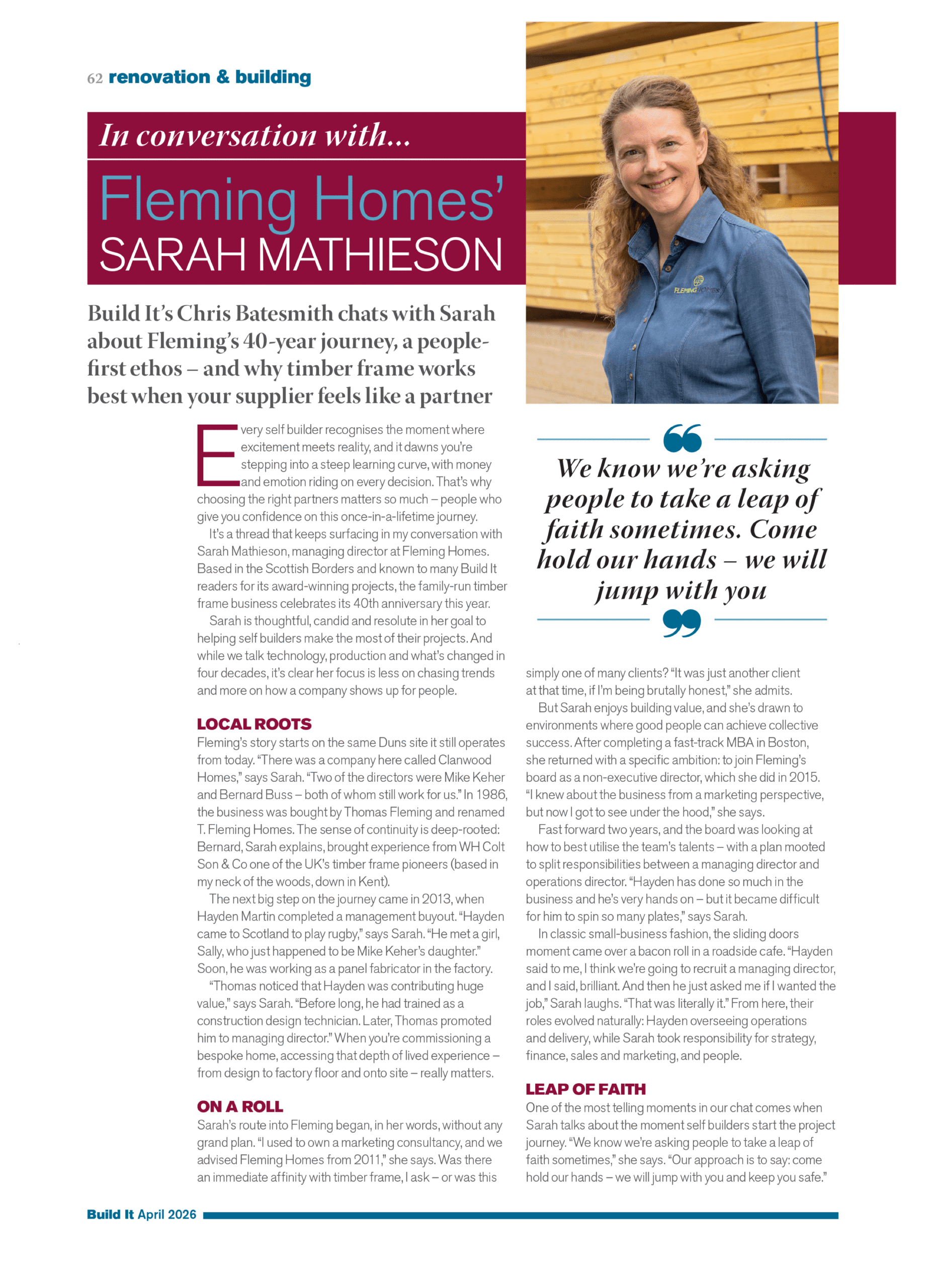
Every self builder recognises the moment where excitement meets reality, and it dawns you’re stepping into a steep learning curve, with money and emotion riding on every decision. That’s why choosing the right partners matters so much — people who give you confidence on this once-in-a-lifetime journey.
It’s a thread that keeps surfacing in my conversation with Sarah Mathieson, managing director at Fleming Homes. Based in the Scottish Borders and known to many Build It readers for its award-winning projects, the family-run timber frame business celebrates its 40th anniversary this year.
Sarah is thoughtful, candid and resolute in her goal to help self builders make the most of their projects. And while we talk technology, production and what’s changed in four decades, it’s clear her focus is less on chasing trends and more on how a company shows up for people.
Local Roots
Fleming’s story starts on the same Duns site it still operates from today.
“There was a company here called Clanwood Homes,” says Sarah. “Two of the directors were Mike Keher and Bernard Buss — both of whom still work for us.”
In 1986, the business was bought by Thomas Fleming and renamed T. Fleming Homes. The sense of continuity is deep-rooted: Bernard, Sarah explains, brought experience from WH Colt Son & Co, one of the UK’s timber frame pioneers (based in my neck of the woods, down in Kent).
The next big step on the journey came in 2013, when Hayden Martin completed a management buyout.
“Hayden came to Scotland to play rugby,” says Sarah. “He met a girl, Sally, who just happened to be Mike Keher’s daughter.” Soon, he was working as a panel fabricator in the factory.
“Thomas noticed that Hayden was contributing huge value,” says Sarah. “Before long, he had trained as a construction design technician. Later, Thomas promoted him to managing director.”
When you’re commissioning a bespoke home, accessing that depth of lived experience — from design to factory floor and onto site — really matters.
On a Roll
Sarah’s route into Fleming began, in her words, without any grand plan.
“I used to own a marketing consultancy, and we advised Fleming Homes from 2011,” she says.
Was there an immediate affinity with timber frames, I ask — or was this simply one of many clients?
“It was just another client at that time, if I’m being brutally honest,” she admits.
But Sarah enjoys building value, and she’s drawn to environments where good people can achieve collective success.
After completing a fast-track MBA in Boston, she returned with a specific ambition: to join Fleming’s board as a non-executive director, which she did in 2015.
“I knew about the business from a marketing perspective, but now I got to see under the hood,” she says.
Fast forward two years, and the board was looking at how to best utilise the team’s talents — with a plan mooted to split responsibilities between a managing director and operations director.
“Hayden has done so much in the business and he’s very hands on — but it became difficult for him to spin so many plates,” says Sarah.
In classic small-business fashion, the sliding doors moment came over a bacon roll in a roadside cafe.
“Hayden said to me, I think we’re going to recruit a managing director, and I said, brilliant. And then he just asked me if I wanted the job,” Sarah laughs. “That was literally it.”
From here, their roles evolved naturally: Hayden overseeing operations and delivery, while Sarah took responsibility for strategy, finance, sales and marketing, and people.
Leap of Faith
One of the most telling moments in our chat comes when Sarah talks about the moment self builders start the project journey.
“We know we’re asking people to take a leap of faith sometimes,” she says. “Our approach is to say: come hold our hands — we will jump with you and keep you safe.”
Information has become much easier to get hold of since 1986, initially thanks to the internet, now through AI. But more information doesn’t always equate to better decisions; hence why self builders need experienced, trusted partners.
What has changed, in Sarah’s view, is confidence.
“I think there’s a lot more confidence now because many of us now know people have built a bespoke home,” she says. “So self building is a lot more visible as a realistic option.”
She tells me about a meeting with potential clients, at January’s NSBRC show in Swindon, who had been sent her way by a previous Fleming Homes customer. Not because they were ready to build tomorrow, but because they wanted a trusted expert to talk them through the journey before they’d even found a plot.
It’s the sort of early-stage conversation we regularly see at Build It Live: learning to ask better questions before leaping.
Growing Up at 40
As Fleming Homes approaches its 40th anniversary, Sarah reflects on what that milestone really signifies.
“Forty is when you’re grown up,” she says. “At 20 you’re not grown up. At 30 you still don’t want to be. At 40, you accept it.”
There’s a quiet confidence in that maturity. Over four decades, the company has navigated recessions, policy shifts and market turbulence.
“We’ve seen companies like ours disappear from the market,” Sarah says. “But we’re still here.”
That longevity signals resilience — and the experience that comes from having delivered thousands of one-off homes.
Indeed, self-build is baked into Fleming Homes’ DNA.
“There’s something beautiful about helping people meet their aspirations for living by creating an individual home that’s entirely unique to them,” she says.
Investing in the Future
Maturity doesn’t mean standing still.
In fact, Fleming Homes has recently put major investment into manufacturing and just opened a new factory — complete with a new Essetre Techno Saw, the first of its kind in the UK.
“That’s a quarter of a million pounds on one piece of kit,” says Sarah.
Why take that step?
In part, because client expectations are shifting.
“People want more done in the factory,” she explains. “More prefabrication, because it speeds up time on site, eliminates additional trades and gives peace of mind around quality.”
The new setup allows Fleming Homes to export directly from design desks to the machine, increasing precision and enabling greater levels of prefabrication — including closed panels, additional insulation layers and more streamlined detailing.
Interestingly, the decision wasn’t about copying competitors. Instead, the focus was on selecting technology that enhanced flexibility and suited Fleming Homes’ approach — refining the process in ways that directly benefit the self builder.
“That’s definitely part of our DNA. We don’t just follow the herd,” says Sarah.
All in a Feeling
As we talk about what makes the company tick, Sarah quotes Maya Angelou:
“I’ve learned that people will forget what you said, people will forget what you did, but they will never forget how you made them feel.”
This, she explains, sits at the heart of Fleming Homes’ purpose.
“It’s important to us that our customers feel that we genuinely care about what they’re trying to achieve,” she says.
It’s not just self builders Sarah’s referring to.
“We also talk about internal customers,” she says. “How I serve the people in this business to enable them to do their jobs to the best of their ability.”
For Sarah, the internal culture and experience outside it are inseparable – twin prongs in helping people achieve the best house they can within their budget.
Fleming Homes delivers quality projects with aplomb; but it’s not the USP.
“Quality and customer service are hygiene,” she says. “You should be delivering those anyway; it doesn’t set you apart.”
Accreditation, such as STA Gold Assured status and ISO 9001 certification, provides reassurance.
But for Sarah, the differentiator is how the journey feels, and the lasting impact Fleming Homes’ work has on self builders. She talks warmly about erection crews stopping in on past clients when travelling between jobs.
“It’s like visiting an old friend,” she says.
If creating your own home is indeed a leap of faith, it helps to know who’s jumping with you.